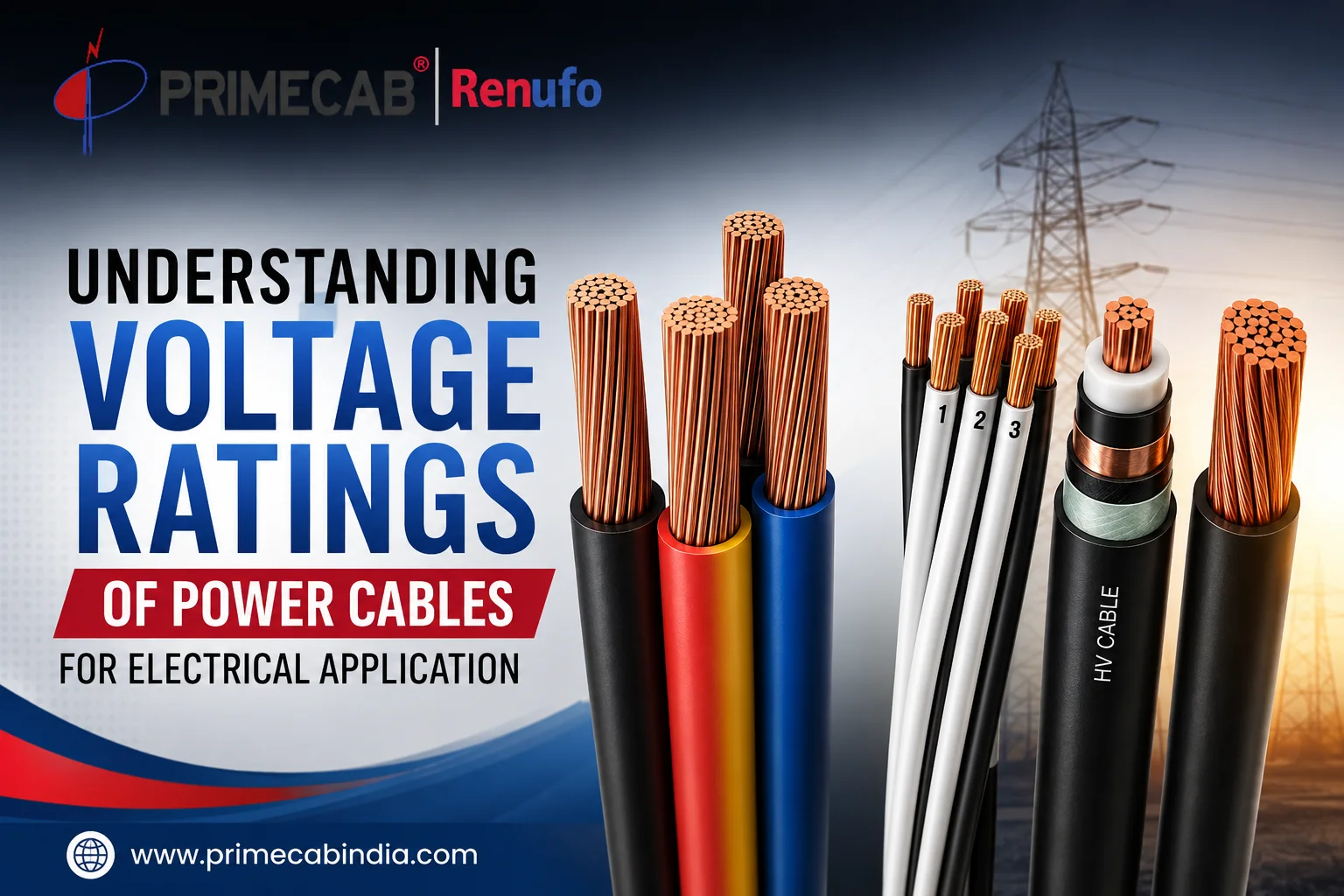
Understanding Voltage Ratings of Power Cables for Electrical Applications
Voltage rating is an important parameter when selecting cables for electrical equipment and power transmission. Exceeding the voltage beyond the given rating poses many potential threats. Overheating, insulation breakage, and high electrical stress resulting in downtime of electrical supply are some of the most common occurrences that are caused when the voltage rating is too low or unreliable. Power cable manufacturers understand this quite well and therefore consider voltage ratings as a crucial parameter while designing the cables.
In this article, we will learn about voltage ratings, how manufacturers decide standard voltage ratings, and voltage ratings of cables in various applications.
What is Voltage Rating
Voltage rating indicates the maximum voltage that the insulation system of a cable can handle while maintaining its stability in electrical conduction. It defines the limit of operation under which insulation and material work properly. It is essential to ensure operational safety, signal integrity, regulatory compliance, longevity, and system reliability.
How Manufacturers Determine Voltage Rating
Power cable manufacturers determine the voltage rating by considering several key factors. Some of these are:
- Insulating material: The dielectric strength of insulating material is a measure of its ability to resist electrical breakdown. It is measured in voltage per unit meter, i.e., the amount of voltage that can be applied across a unit thickness. It is dependent on the material of insulation; therefore, material selection is directly impacted by voltage rating.
- Insulation thickness: The higher the thickness of insulation, more is the capacity of the cable to safely handle the voltage without leaking current. Standard voltage rating decides the insulation thickness as per the suitable requirement of the cable.
- Environmental Factors: Temperature, altitude, humidity, air pressure, mechanical vibration, and frequency of operations also impact voltage handling capacity. Hence, these factors affect insulation material, thickness, or the choice of additional material or specialized manufacturing processes as per standards.
Voltage Ratings of Power Cables in Various Applications
Various electrical systems make use of cables with appropriate voltage ratings according to system voltage, load requirements, installation circumstances, and type of power distribution system. Prime Cable India provides power cables for these respective applications:
1. Low-Voltage Power Distribution
1.1 kV low-voltage cables are installed to distribute electricity in low-voltage applications such as industrial, commercial, construction projects, and infrastructure.
2. Aerial Power Distribution
1.1 kV overhead insulated cables are used in overhead low-voltage distribution networks, characterized by insulated cables that are structured in a compact way.
3. Solar Power Applications
DC solar cables are employed to transmit direct current between photovoltaic panels and other components of the solar system whose design matches outdoor solar applications.
4. Medium-Voltage Power Distribution
3.3 kV to 33 kV cross-linked polyethylene cables are used in medium-voltage power distribution in substations, industries, utilities, and infrastructure applications.
5. Industrial and Commercial Applications
Industrial and commercial establishments require multiple types of cables with varying voltage ratings based on the requirements of their electrical distribution systems, equipment used, and purpose, and installation conditions.
Conclusion
Voltage rating is a crucial standardization parameter for designing power cables. Different applications have different voltage ratings, which determine the choice of material and fabrication process. Power cable manufacturers like Prime Cable India are experts in producing cables of diverse voltage ratings that follow national standards for suitable applications across industries, commercial spaces, and residences. They ensure safety and minimal downtime, making electrical systems more cost- and energy-efficient.